Breaking Through Ancestral Patterns
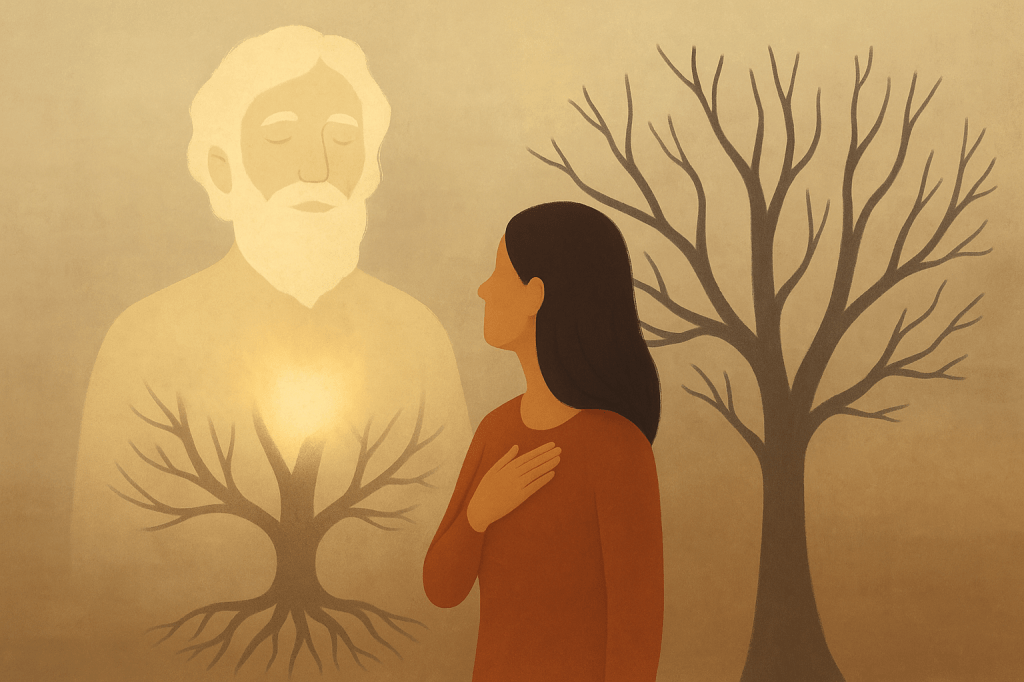
We each carry stories in our bones. Some are our own. Many are not. They have been passed down like an unspoken inheritance — beliefs, fears, and behaviours shaped by the experiences of those who came before us.
In the language of trauma healing, this is ancestral wounding: the transmission of pain, survival strategies, and distorted identities from one generation to the next. Modern science calls it epigenetics — the study of how trauma and environmental stressors can alter gene expression, leaving imprints that echo across generations.
But alongside the wounded lineage exists another truth: somewhere in your ancestry is a healthy ancestor, one who lived before the rupture, before the wounding took root. This ancestor is part of your inheritance too — and through intentional healing, you can reconnect to this root of wholeness and re-form your identity from a place set before trauma.
Ancestral Wounding and Epigenetics
Research into epigenetics has confirmed what indigenous wisdom has long known: trauma can be inherited. Studies have shown that famine, war, displacement, and abuse can leave biochemical marks on our DNA, influencing stress responses and emotional regulation in future generations.
Gabor Maté writes in When the Body Says No that these inherited patterns often show up in ways that are unconscious — a heightened stress response, a tendency to self-abandon, an inability to rest — and are mistaken for personality traits rather than echoes of ancestral survival.
We may never have lived the events our grandparents endured, yet our nervous systems can still be tuned to the frequency of their fear, shame, or grief.
The Loss of Right Relationship
In many indigenous traditions, health is defined not only as the absence of illness, but as being in right relationship — with oneself, with others, with the earth, and with the unseen.
Wounding disrupts right relationship. Abuse, oppression, war, and displacement pull us out of our natural belonging. We lose trust — in ourselves, in life, in others. The survival adaptations that follow — mistrust, control, avoidance, people-pleasing — may help us get through, but over time, they obscure the truth of who we are.
When ancestral trauma goes unacknowledged, the patterns of “not enough,” “not safe,” and “not worthy” repeat. We build identities around them, mistaking the adaptations for the Self.
Meeting the Healthy Ancestor
Part of ancestral healing is the practice of seeking out the healthy ancestor — the one whose life force still flows in you, who carried strength, joy, dignity, and wholeness.
This isn’t about finding a “perfect” person in your family tree, but about recognising that before the wound, there was health. Somewhere in your lineage is someone who knew how to live in right relationship, who had their own ways of cultivating connection, purpose, and belonging.
Connecting to this ancestor — through meditation, ritual, storytelling, or prayer — offers a living template for your own reclamation. They remind you: you are not only the wound, you are also the wholeness that came before it.
Reshaping Identity from the Core
Peter Levine’s work in Somatic Experiencing emphasises that trauma healing isn’t just about remembering the story, but about completing the interrupted survival responses stored in the body. This is equally true for inherited trauma.
When we work somatically — slowing down, tracking sensations, creating safety in the nervous system — we begin to distinguish between the survival adaptations we inherited and the deeper Self that existed before them.
This is where identity reshaping begins:
- Recognising the pattern (e.g., “This tendency to overwork isn’t me, it’s my grandmother’s survival response after displacement.”)
- Honouring its purpose (acknowledging that it kept the lineage alive).
- Choosing differently (grounding in present safety to act from Self rather than survival mode).
Practices for Returning to the Self Before the Wound
1. Ho’oponopono – Hawaiian Practice of Reconciliation
This ancient practice is about cleaning the spiritual channels between yourself, your ancestors, and life. The phrases — I’m sorry. Please forgive me. Thank you. I love you. — can be directed to your own wounded parts, to ancestors who passed the pain down, and to the healthy ancestor who holds the blueprint of wholeness.
2. Tara Brach’s RAIN Meditation
- Recognise what’s arising (a belief, a fear, a tightening in the chest).
- Allow it to be there without pushing it away.
- Investigate its roots with kindness — “Who does this belong to?” “Is this even mine?”
- Nurture the part of you that feels small, scared, or shamed — offering the compassion it never received.
3. Right Relationship Rituals
Drawing on Native American and other indigenous teachings, create intentional moments to repair right relationship:
- Offer prayers or tobacco to the land.
- Speak aloud gratitude to your body.
- Acknowledge the ancestors and name both the wound and the gifts they passed on.
4. Somatic Repatterning
From Peter Levine’s work — gently guide the body into experiences of safety that contradict the old trauma imprint. This could be resting under a warm blanket, standing barefoot on the earth, or breathing slowly while recalling a memory of safety. These moments start to rewire the nervous system toward trust.
The Spiral Path of Healing
Healing inherited trauma isn’t linear. It’s a spiral — we return to the same patterns at deeper levels, each time with more capacity and insight. The goal isn’t to erase the past, but to reclaim agency in the present.
When you connect with the healthy ancestor within your lineage, you anchor into a truth that precedes trauma. When you restore right relationship — with yourself, with your body, with the world around you — you interrupt the cycles of survival and make space for new, life-affirming patterns to take root.
And when you reshape identity from this core place, you become a living bridge — carrying forward not just the wound, but the wholeness that was always there, waiting to be remembered.

If you’d like to explore ancestral trauma work in a safe, compassionate space, I offer one-to-one sessions in-person in Somerset and online across the UK.
Together, we can walk gently toward the parts of you that are ready to be seen.
Send me a message
To book a free 20 minute consultation


 Counselling Street Glastonbury & Online